From Silent Films to Talkies
The sound revolution of 1927. How The Jazz Singer, Vitaphone and sound-on-film transformed movies between 1926 and 1930, ending some star careers and launching many new ones.
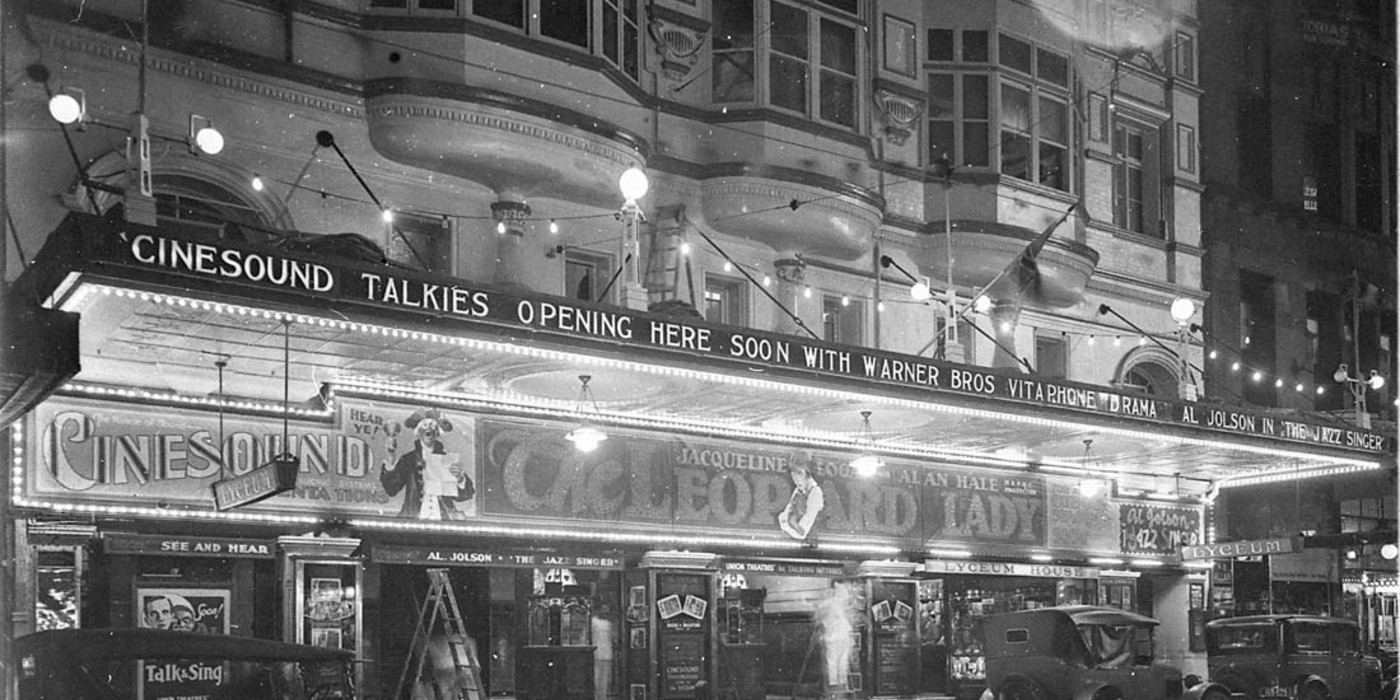
Sydney cinema announcing talkies, 1928: photographed by Sam Hood, Public domain
Silent, but never quiet
Silent films were rarely watched in silence. Pianists, organists or full orchestras played along in cinemas, and title cards carried dialogue. Actors communicated with faces and bodies, which helped films travel the world, because title cards were easy to translate. Stars such as Charlie Chaplin and Buster Keaton built global careers this way.
Vitaphone and The Jazz Singer
Warner Bros. bet on Vitaphone, a system that played a large phonograph disc in sync with the projector. Don Juan (1926) used it for music and sound effects. Then The Jazz Singer, which premiered in New York on 6 October 1927, let audiences hear Al Jolson sing and speak a few lines, including the famous promise that you ain't heard nothing yet. Crowds were thrilled.
In 1928 Warner Bros. released Lights of New York, the first feature with dialogue all the way through.
Sound on film wins
Discs could skip or fall out of sync, so the industry soon moved to sound-on-film, where the soundtrack is printed as a strip beside the pictures. Fox Movietone and RCA Photophone systems spread fast, and by the early 1930s nearly every Hollywood film was a talkie.
Chaos on the set
Early sound recording was difficult. Noisy cameras were sealed inside soundproof booths, so they could hardly move, and microphones were hidden in vases and lamps, forcing actors to stand still near them. Engineers soon invented the boom microphone on a pole and quieter camera housings, and film became mobile again.
Some silent stars struggled with the change, while actors with stage training and strong voices arrived from Broadway. Studios advertised big debuts, such as Greta Garbo speaking for the first time in Anna Christie (1930).
Remembering the change
The musical Singin' in the Rain (1952) turned the chaos of early talkies into comedy, and The Artist (2011), a mostly silent film about a silent star, won the Academy Award for Best Picture. For the stars of this era, read our Charlie Chaplin and Buster Keaton pages, and see the film history timeline.
Did you know?
Many early sound films were shot in several languages at once, with different casts using the same sets, before dubbing and subtitles became common. Some silent stars with foreign accents found the change hard, while others, like Greta Garbo, turned their voices into part of their mystique.
Studios also had to rebuild cinemas: thousands of theaters installed speakers and sound projectors between 1928 and 1930, and the orchestras and organists who had played along to silent films lost their jobs.
- Sydney cinema announcing talkies, 1928: photographed by Sam Hood, Public domain
Text written by Amazing Movie Star.